 Image 1 of 3
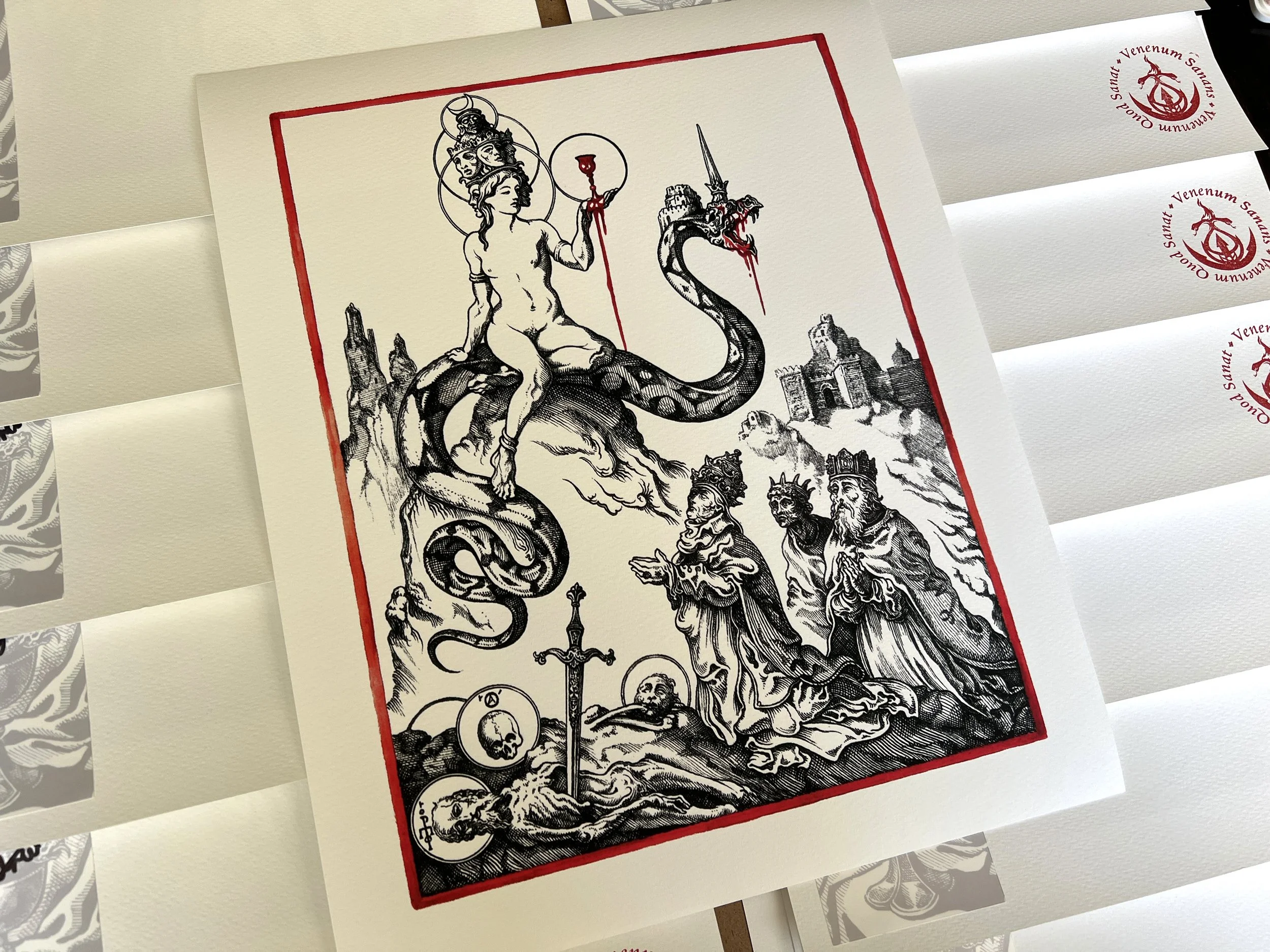 Image 2 of 3
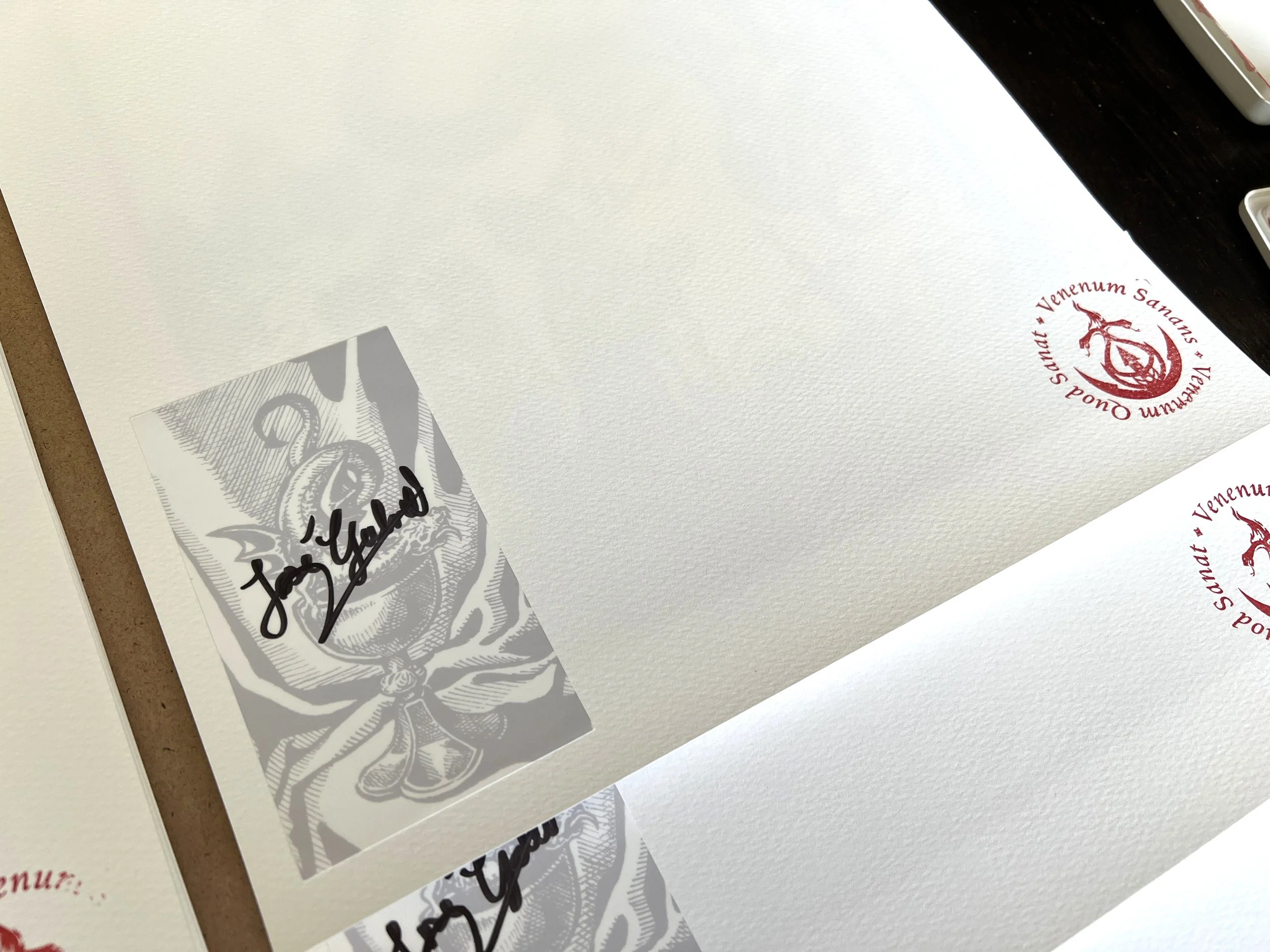 Image 3 of 3
N.B.: Art Prints are shipped separately from other items due to their box format, so please order them separately from other books or items to avoid extra shipping charges.
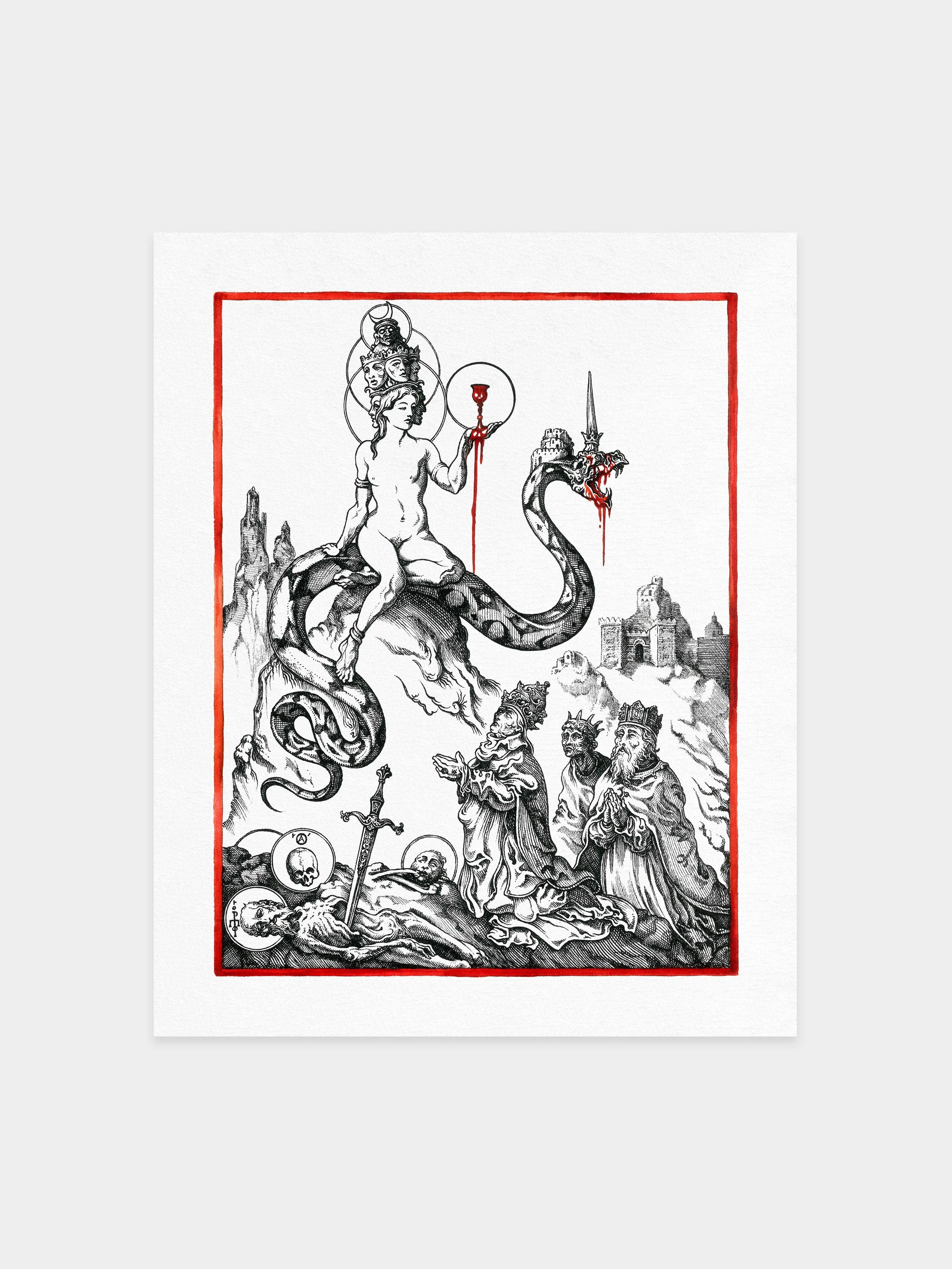
Babalon the Great, Woman of Babylon
by Jose Gabriel Alegría Sabogal
11” X 13.75” - Printed on lavish and highly-textured Velvet Fine Art Paper 260 gsm paper-carton.
Limited to approx. 150 signed and stamped copies.
This drawing is a play of words translated onto an image. In Dante’s Inferno, the infamous Whore of Babylon is described as having 7 heads herself, instead of, as traditionally visualized by painters, the dragon being multi-headed. This called to my attention that the passage in Revelation 17:3 can indeed be understood in both ways: “There I saw a woman sitting on a scarlet beast that was covered with blasphemous names and had seven heads and ten horns.”
In the words of Charles T. Davis “Dante eliminates the beast and gives the seven heads to the woman, thereby identifying her firmly with Rome, the papal as well as the imperial city (Davis, 1998, p.269):
"She who was born with seven heads and had / the power and support of the ten horns"
(Inferno XIX: 109-111, Mandelbaum, 1995).“quella che con le sette teste nacque,
e da le diece corna ebbe argomento”
(Inferno XIX: 109-111, Petrocchi, 2008)
She is described as sitting on the seven hills (implicitly the seven sacred hills of ancient Rome) a link to Dante’s imperial and anti-papal views, and she has also been depicted in medieval visual tradition as sitting on the hills only, or on a hill with seven rivers, see for example the so-called Paris Apocalypse (Ms. Français 403, fol.33r.) and the Gulbenkian Apocalypse (fol.58).
I however have chosen to include the beast and the city combined, although in a simplified way, given the play of words for “draco” to mean both serpent and dragon. In the end, it is also in Revelation that Satan is referred to as “that old serpent”. This serpent has one horn as is wounded, the miracle through which the Antichrist would convert the gullible to worship him, tropes that st. John took from the prophecy of Daniel 7.
The Greek inscriptions on the haloes of the slain saints are the abbreviations for “prophet” and “apostle” as inscribed in the Porta Byzantina of the papal Basilica of San Paolo fuori le mura. They have been slain with the blessed sword (stocco benedetto) that was a papal gift to kings and emperors, last awarded in 1823.
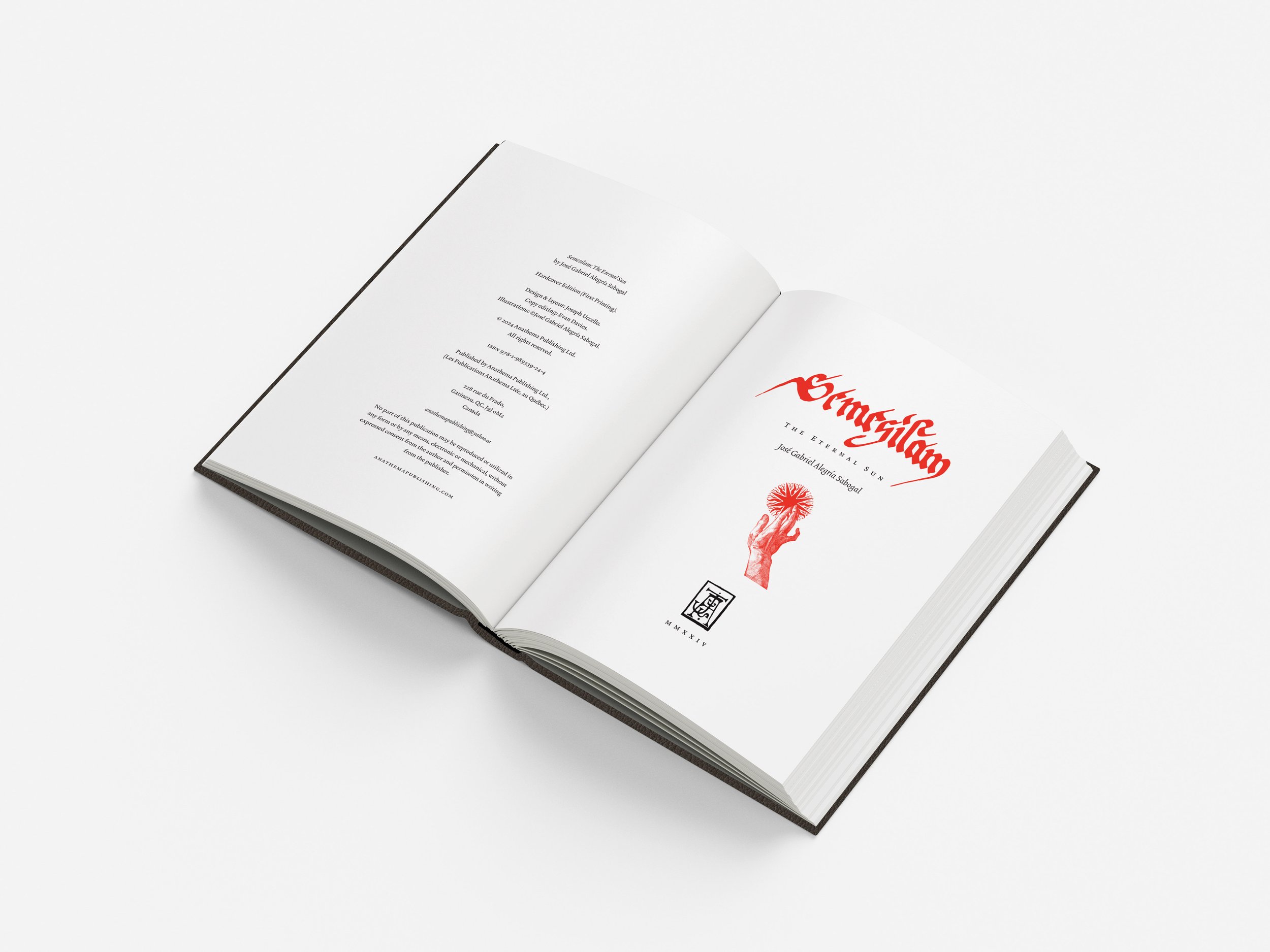
The term babálon is Enochian for “to the wicked” as recorded by John Dee (Sixth Key, 6:12, James, 2009) and rose to prominence in Thelema to designate the Scarlet Woman, a particular interpretation of the apocalyptic figure of the whore. I rendered a previous version of the Whore of Babylon as fully clothed, which I have published a couple of times (Handbook of Sacred Anatomy, Semesilam) where she is based on Dürer’s sketch for the Slander of Apelles, from 1522, preserved in the Albertina in Vienna (nr.3177). Even though the current version is less prudish, it is always my aim to depict dignity in damnation. Lastly, the landscape behind is a mixture of St. Peter’s and the Gate of Ishtar, expressing Dante’s conflation of the two seats of power.
N.B.: Art Prints are shipped separately from other items due to their box format, so please order them separately from other books or items to avoid extra shipping charges.
Babalon the Great, Woman of Babylon
by Jose Gabriel Alegría Sabogal
11” X 13.75” - Printed on lavish and highly-textured Velvet Fine Art Paper 260 gsm paper-carton.
Limited to approx. 150 signed and stamped copies.
This drawing is a play of words translated onto an image. In Dante’s Inferno, the infamous Whore of Babylon is described as having 7 heads herself, instead of, as traditionally visualized by painters, the dragon being multi-headed. This called to my attention that the passage in Revelation 17:3 can indeed be understood in both ways: “There I saw a woman sitting on a scarlet beast that was covered with blasphemous names and had seven heads and ten horns.”
In the words of Charles T. Davis “Dante eliminates the beast and gives the seven heads to the woman, thereby identifying her firmly with Rome, the papal as well as the imperial city (Davis, 1998, p.269):
"She who was born with seven heads and had / the power and support of the ten horns"
(Inferno XIX: 109-111, Mandelbaum, 1995).“quella che con le sette teste nacque,
e da le diece corna ebbe argomento”
(Inferno XIX: 109-111, Petrocchi, 2008)
She is described as sitting on the seven hills (implicitly the seven sacred hills of ancient Rome) a link to Dante’s imperial and anti-papal views, and she has also been depicted in medieval visual tradition as sitting on the hills only, or on a hill with seven rivers, see for example the so-called Paris Apocalypse (Ms. Français 403, fol.33r.) and the Gulbenkian Apocalypse (fol.58).
I however have chosen to include the beast and the city combined, although in a simplified way, given the play of words for “draco” to mean both serpent and dragon. In the end, it is also in Revelation that Satan is referred to as “that old serpent”. This serpent has one horn as is wounded, the miracle through which the Antichrist would convert the gullible to worship him, tropes that st. John took from the prophecy of Daniel 7.
The Greek inscriptions on the haloes of the slain saints are the abbreviations for “prophet” and “apostle” as inscribed in the Porta Byzantina of the papal Basilica of San Paolo fuori le mura. They have been slain with the blessed sword (stocco benedetto) that was a papal gift to kings and emperors, last awarded in 1823.
The term babálon is Enochian for “to the wicked” as recorded by John Dee (Sixth Key, 6:12, James, 2009) and rose to prominence in Thelema to designate the Scarlet Woman, a particular interpretation of the apocalyptic figure of the whore. I rendered a previous version of the Whore of Babylon as fully clothed, which I have published a couple of times (Handbook of Sacred Anatomy, Semesilam) where she is based on Dürer’s sketch for the Slander of Apelles, from 1522, preserved in the Albertina in Vienna (nr.3177). Even though the current version is less prudish, it is always my aim to depict dignity in damnation. Lastly, the landscape behind is a mixture of St. Peter’s and the Gate of Ishtar, expressing Dante’s conflation of the two seats of power.